Facebook Messenger Adds Video Calls

You can now make video calls with Messenger. Facebook’s messaging app added a video calling feature today in the US, UK, Canada, and a variety of other countries.
If you’re talking to a friend and realize that you want to see their face, not another Pusheen sticker, the feature lets you call them up on the spot.
You can quickly start a video call from any conversation with just one tap. If you’re messaging with someone and realize that words just aren’t enough, you can simply choose the video icon in the top right corner of the screen and start a video call right from within an existing Messenger conversation.
Phone calls will start with the front-facing camera turned on, but you can switch it to show whoever you’re talking to what’s going on around you.
For those of us who fear spontaneous face-to-face contact, this is kind of horrifying. But Facebook’s counting on an audience. This is another bid to push Messenger as its own communication platform, and it’s a big one, putting Facebook in direct competition with popular VoIP services like Skype, Google Hangouts, and Apple’s FaceTime.
The big advantage Messenger has here is a built-in contact list— there’s no need to go through the process of finding someone’s user info if they’re already your Facebook friend. That built-in contact list is also what Facebook’s counting on to compete with Venmo when it comes to sending money to friends. [Facebook]
from ffffff http://gizmodo.com/facebook-messenger-adds-video-calls-1700443570
via IFTTT

Anonymous: Still Trolling After All These Years

Yesterday, an environmentalist faction of Anonymous took down a Hawaiian state government website and a site for the Thirty Meter Telescope project, a controversial effort to build the world’s second largest telescope atop Mauna Kea. You’ve probably never heard of Operation Green Rights. But that’s the point.
Believe it or not, Anonymous still exists. Through focused groups like Operation Green Rights, the quasi-infamous and purportedly leaderless band of hacktivists is still stirring up shit. They’re just not stirring up very much of it, and—as always—convoluting the issues at stake.
In their recent action, Operation Green Rights hit the telescope project and the Hawaiian government sites with direct denial of service (DDoS) attacks, taking them offline for about two hours. Mauna Kea, already home to over a dozen international telescopes, is considered the most sacred mountain of the native Hawaiian people. Some groups are protesting adding another large scope to the peak. However, the issue is political rather than environmental, and even Hawaiians are divided on whether or not the telescope would be good for the region. The DDoS attack coincided with a series of protests in the streets of Honolulu.

As usual, not much happened with the DDoS attack. Hawaiian officials reported no measurable consequences of the incident. According to the Associated Press report, “The group’s Twitter posting drew relatively minimal reaction, with 18 retweets and 33 ‘favorites.’”
Those numbers have since increased (slightly) since then. But it’s nothing like the days when Anonymous ops used to command the world’s attention. Remember the Scientology attack? Remember Operation Payback? Remember the HBGary emails? Remember when people were really scared of Anonymous?
Still, this wing of Anonymous is aiming high. Operation Green Rights has actually been organizing actions for four years, taking on everyone from the World Wildlife Foundation (WWF) to Monsanto. The targets are ostensibly those who destroy the environment, though the group claims in its almost incomprehensible manifesto that they’re pretty much after anyone who “commits murder, exploit and oppress [sic.] people and goes against the principles of democracy human respect against the principles of democracy and human respect.” So pretty much anyone who is evil.
It’s easy to brush off all of those empty threats we’ve seen Anonymous make over the years because they’re often so random. (At one point, an Anonymous faction vowed to take down Facebook because Facebook.) But Operation Green Rights at least has a nominal target.
Last year, this particular faction successfully obtained and released personal details of over 10,000 accounts from global corporations and governments—an apparently random collection of employees connected to the EU Sustainable Energy meeting. Just before that, Operation Green Rights claimed to have hacked into the accounts of some 1,800 environment-destroying companies like Dow, Dupont, Bayer, and, again, Monsanto. All along the way, it’s unclear whether the actions were specifically targeted at environmental issues or simply focused on sparking disruption.
So Anonymous is still capable of causing a ruckus. And Operation Green Rights, for one, seems hell bent on getting its message out there. Whatever that message might be.
from ffffff http://gizmodo.com/anonymous-still-trolling-after-all-these-years-1700374189
via IFTTT
Microsoft is BEATING Amazon's cloud revenues. Cough cough
Azure revenues are beating AWS and Microsoft is overtaking Amazon on the cloud IT highway.
That's if analyst haus Stifel Nicolaus's data is correct.
Back in 2012's third quarter Microsoft commercial cloud revenue was $254m, with Amazon Web Services (AWS) ahead at $530m. In the first quarter of 2015 AWS revenues totalled $1.566bn, with Microsoft nudging ahead for the first time at $1.575bn.
Stifel MD Aaron Rakers writes: "Microsoft ... reported Commercial Other revenue at ~$2.76bn in 1Q15, an increase from $1.9bn in the year-ago quarter. Within this, we would find the implied Commercial Cloud revenue of $1.57bn was up from $746m in the year-ago quarter and $1.4bn in the prior quarter."
Here's the chart showing the revenues in question:
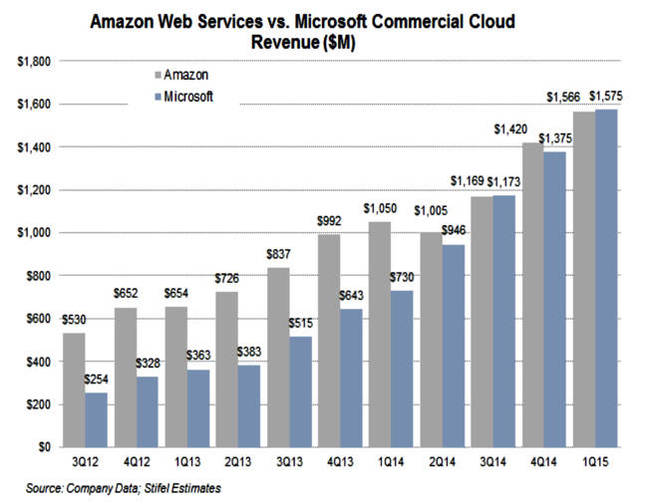
AWS vs Microsoft commercial cloud revenue
Rakers notes Microsoft as saying:
- Customer usage of Azure compute more than doubled yr/yr during the quarter
- More than five million organisations are represented in the Azure activity directory, with more than 425 million identities
- The 50 trillion objects stored in Azure is up threefold yr/yr
- Storage transactions added up to more than five trillion during the month of March
- Azure hosts more than one million websites.
Well, well; it seems Bezos is beatable and Amazon is not an invincible onrushing tank. However, Register 'riter Gavin Clark argues Microsoft is artificially bulking up its cloud revenues but he thinks Nadella's cloud mob could actually overtake the Bezos bunch soon. ®
Sponsored: Benefits from the lessons learned in HPC
from ffffff http://go.theregister.com/feed/www.theregister.co.uk/2015/04/27/microsoftazure_beating_amazon_aws_revenues/
via IFTTT
Here's The Trailer For The New Batman Game — 'Arkham Knight'
This won't be out until the end of June, but watch the trailer for a glimpse at some of the gameplay, which includes playing as Robin, Nightwing and Catwoman.
from ffffff http://digg.com/video/arkham-knight-game-trailer
via IFTTT
Drones Buzz Golden Gate Bridge, Prompting Security Fears

The quake-prone Bay Area is already a pretty precarious area for bridges, but now suspicious drone activity is also a concern for San Francisco’s famous Golden Gate.
Officials are now reportedly spotting drones near the bridge several times a month, and one even crashed into the road. Those San Francisco officials understandably have some security concerns, since the world-famous symbol of American engineering attracts 10 million visitors a year and ferries over 100,000 vehicles’ worth of commuters a day.
Of course, drone flybys are nothing new: the small, hovering, camera-equipped unmanned aircraft have been making sketchy appearances all around the world’s major landmarks this year. Just last week, a guy landed a drone carrying radioactive sand onto Japanese Prime Minister Shinzo Abe’s office roof. Earlier this year, another drone (sans contaminated granules) crashed near the White House, and others were seen around the Eiffel Tower.
With bridges in particular, drones can gain easy aerial access to the otherwise inaccessible structures. This can be good and bad: Some civil engineers think that we can use drones to survey the structrual condition of the beams and joints of a bridge—which can be especially advantageous with older structures. (The Golden Gate Bridge was built around 80 years ago.)
But law enforcement is on the lookout for people who might use the information-gathering technology for nefarious purposes. Last year, two men were arrested after they were caught flying drones near New York City’s George Washington Bridge, nearly coming within striking distance of an NYPD helicopter at 2,000 feet. Right now, laws surrounding personal and recreational drone use are still pretty nebulous.
As far as the Golden Gate Bridge goes, though, they take security pretty seriously. Since 9/11, the Golden Gate Bridge Highway and Transportation District received around $15 million in grants to beef up security. Sounds like some of that could be going toward anti-drone enforcement.
[Marin Independent Journal via Ars Technica]
Image via Getty
from ffffff http://gizmodo.com/drones-buzz-golden-gate-bridge-prompting-security-fear-1700399865
via IFTTT
Why Is the Paper Clip Shaped Like It Is?

When you think of paper clips, you immediately think of a specific form—the familiar round-ended, double-loop design. The wire trombone shape. But that’s only one variety of clip; the “Gem,” which gets its name from a British company called Gem Manufacturing Limited, which, even if it wasn’t directly involved with the development of the clip, was clearly able to market it well enough that the name stuck. There are many different (and some might say better) types of paper clip.
How can it be that we have no real idea of who invented it? One difficulty is that with so many different forms, so many different designs, there are just as many pretenders to the throne.
One common theory is that the paper clip was invented by a Norwegian patent clerk named Johan Vaaler in 1899. His patent application (filed in Germany in 1899 and then two years later in the United States) was for a clip made from “a spring material, such as a piece of wire, that is bent to a rectangular, triangular or otherwise shaped hoop, the end parts of which wire piece form members or tongues lying side by side in contrary directions.” One of the illustrations he included in his application did in some way resemble a Gem, but as the Early Office Museum Web site (my favorite place on the Internet) so brutally puts it, “His designs were neither first nor important.”

Vaaler’s title as the supposed father of the paper clip was given to him posthumously. And as the story grew, it accidentally managed to turn him into a folk hero of sorts in Norway. During the years of Nazi occupation, the paper clip was worn as a symbol of resistance in Norway. It was meant as a subtle sign—the binding action of the paper clip serving as a reminder that the Norwegian people were united together against the occupying forces (“we are bound together”). In the years following the war, belief that Vaaler had invented the clip began to spread. The story started appearing in Norwegian encyclopedias and soon merged with stories of the resistance to elevate the paper clip into something approaching a national symbol.
Above image: Norway’s paperclip stamp. Kyle MacDonald/Creative Commons
In 1989, the BI Business School erected a twenty-three-foot-tall paper clip in Vaaler’s honor on their Sandvika campus (this statue was later relocated to the Oslo campus). However, the statue is not actually of the same design Vaaler patented—it’s a modified Gem (one end of the clip being slightly squared). Similarly, ten years later, when Vaaler was commemorated on a Norwegian postage stamp, it was a Gem which was shown next to his picture rather than the clip he actually designed.
The Many (Other) Inventors of the Paper Clip
In the late nineteenth century, three things happened which changed that ecosystem and allowed a new species—the paper clip— to emerge.
Most obviously, for the paper clip to exist at all, you need the technology to reliably produce steel wire with the elastic properties which the clip requires in order to function successfully. Secondly, you need to be able to manufacture and sell these wire clips at a cost which is acceptable to the public. Finally, you had a burgeoning bureaucracy—a side effect of the industrialization which enabled the first two factors. It was the birth of the office environment, and a new infrastructure was required. More paperwork necessitated some new method of organization; the era of the paper clip was born.
From 1867 onwards, a bewildering number of patents were applied for by a host of inventors all hoping to find the best way of using a single piece of metal to attach two or more sheets of paper together. These alternative clips took many forms. There was the “Eureka” clip, a sort of segmented oval shape, cut out of a sheet of metal with a central prong to hold the papers together, patented by George Farmer in 1894; the “Utility” clip from 1895, which was similar to an old-fashioned ring pull, folded back on itself; the “Niagara,” which was basically two of Fay’s clips joined together, patented in 1897; the “Clipper,” a pointy version of the Niagara from the same year; the “Weis” clip, an equilateral triangle within an isosceles, patented in 1904; the spectacularly named “Herculean Reversible Paper Clip,” where the wire was bent into two slightly wonky isosceles triangles; the “Regal” or “Owl” clip, which sort of looked like an owl, if the owl had been raised in a rectangular cage which was too small for it and grew up deformed into a weird boxy shape; and the “Ideal” clip, a complex butterfly-shaped wire arrangement, patented in 1902. The list goes on and on: the “Rinklip,” the “Mogul,” the “Dennison,” the “Ezeon.”
Despite this period of wild experimentation, the narrow doubleloop form of the Gem has remained the most enduring paper clip design.

The first time a recognizable Gem-type clip appears in patent literature is in 1899. William Middlebrook applied for a patent (above) for a machine to automatically manufacture “wire clips for binding or securing papers in lieu of pins,” and included in the patent application is an image showing the “general shape and character” of the clips the machine manufactured. However, the Gem was actually known for at least a decade before that. Professor Henry Petroski (author of The Evolution of Useful Things) cites an 1883 edition of Arthur Penn’s The Home Library, which celebrates the Gem for its superiority over other devices for use in “binding together papers on the same subject, a bundle of letters, or pages of a manuscript.”
A Perfect Design?
Often cited as an example of “perfect” design, the Gem has been featured in exhibitions at the Museum of Modern Art in New York and the Vitra Design Museum in Germany. Emilia Terragni, one of the editors of the Phaidon Design Classics series, named the paper clip as one of her favorite objects:
Because in the paper clip you have the essence of design: you have beautiful design; you have a simple mechanism; you have something that’s never changed in a hundred years—it’s still the same. It’s still very functional and everybody uses it.
But . . . is the Gem paper clip really as perfect as so many claim? If the clip is used to hold together a particularly thick document, it can become distorted and bent out of shape. In many ways, its functional qualities have become overstated as the simplicity of its design has become cherished.
The claim that the design has not changed in a hundred years is also questionable. It’s true that the paper clips available today are very similar to those illustrated in advertisements from the 1890s. But there are also lots of paper clips that share many of the characteristics of the Gem, but which have been given subtle tweaks here and there. You can get “lipped” clips, where the bottom of the inner loop is raised, to allow the clip to slide on more easily (although this idea has been around since George McGill’s patent of 1903). Another variation is the “Gothic” clip, designed by Henry Lankenau in 1934—whereas the classic Gem has rounded Romanesque ends, the “Gothic” clip has a squared top, allowing it to lie flush with the top of the paper, and a pointed bottom, making it easier to attach. “Corrugated” clips provide extra friction, preventing the clips from sliding off so easily. The differences are slight, but changes have been made. From a recent trip to Ryman, I’d say that the paper clips were split about 50/50 between pure Gem-like clips and modified versions.
So why is there this prevailing belief that the Gem represents perfection, when the reality is that it’s actually not quite as good as everyone thinks?
The belief seems to come from the fact that on almost every level the Gem is more than satisfactory. It’s not perfect, but it’s good enough: 8/10 all around. When a tweak is made, the new design performs better in some ways but then worse in others. The “lip” makes it easier to slide on, but can make a pile of documents bulkier. The “Gothic” clip is also easier to use, but the pointed end can scratch or tear papers. The “corrugated” clip is less likely to slide off accidentally, but it’s then more fiddly to remove. The Gem isn’t perfect, and people will continue to try to improve it, but the struggle will be to find a new design that is as balanced as the Gem.
Adapted from The Perfection of the Paper Clip by James Ward. Copyright © 2014 by James Ward. Originally published as Adventures in Stationery in Great Britain by Profile Books Ltd. Reprinted by permission of Touchstone/Simon & Schuster.
Top image via the Early Office Museum
from ffffff http://gizmodo.com/why-is-the-paper-clip-shaped-like-it-is-1699985310
via IFTTT






 Entradas


